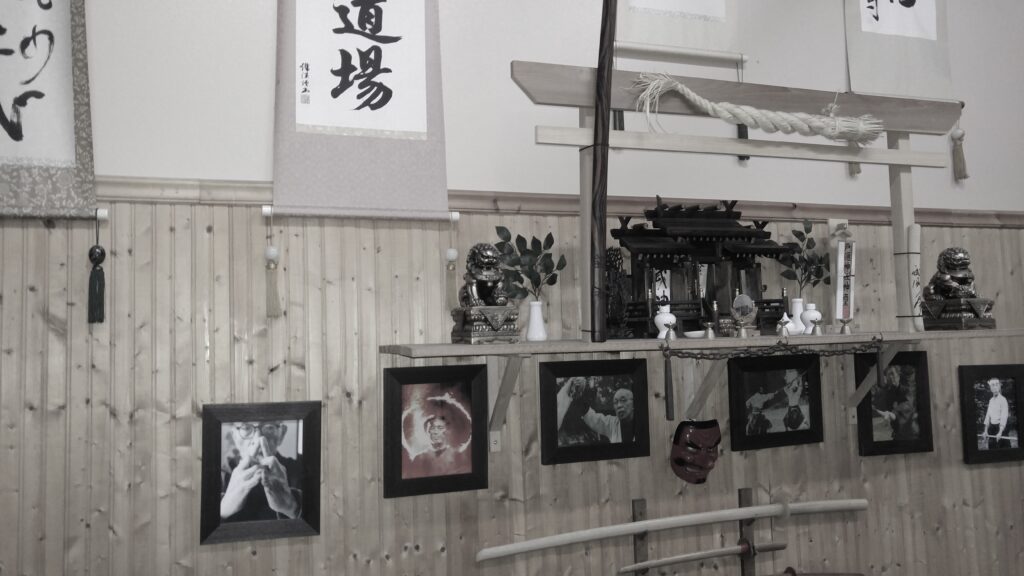
What does Bujinkan mean?
Bujinkan is a Japanese word that translates approximately as ‘Divine warrior school’.
The Bujinkan is an international organization founded by Dr. Masaaki Hatsumi, the retired Sōke (grandmaster), to preserve and promote the teachings of nine classical ryū (martial schools) of traditional Japanese warrior arts. These are the traditions we continue to study and train in today.
• Togakure-ryu Ninpo
• Gyokko-ryu Kosshijutsu
• Kukishinden-ryu Taijutsu
• Shindenfudo-ryu Dakentaijutsu
• Gyokushin-ryu Ninpo
• Koto-ryu Koppojutsu
• Gikan-ryu Koppo Taijutsu
• Takagiyoshin-ryu Jutaijutsu
• Kumogakure-ryu Ninpo
What does training comprise of?
Each class is unique, but there are some elements we return to every time. Training always includes reinforcing fundamental movements and foundation skills, along with practicing ukemi (rolling and safe falling) so students can train with confidence and avoid injury.
From there, we explore the principles, techniques, or weapons of one or more of the nine schools. Rather than learning them as fixed routines, we study how they can be applied in different contexts and adapted to a variety of situations. This approach develops flexibility, creativity, and a deeper understanding of the art.
How much are classes?
We don’t post training fees online. Please feel free to email or call us directly, and we’ll be happy to go over the details with you. Since this is a new training group in Las Vegas, our current pricing is kept very reasonable while we establish the dojo here.
What is the proper attire for training?
Proper attire includes a martial arts uniform known as a do-gi for enrolled students. New students can wear workout clothing.
How long does it take to get a black belt?
Progress varies from person to person. Advancement depends on each student’s effort, comprehension, consistency, and ability. For some, it may take several years; for others, a shorter time.
As a general guideline, it usually takes a minimum of about three years of steady training before reaching certain levels. However, each dōjō sets its own ranking requirements, which are determined by the Shidōshi (licensed instructor) or Shihan (senior teacher) leading the training.
The most important thing is not how quickly you earn rank, but how deeply you develop your skills, understanding, and spirit through training.
Can I attend all classes if I join?
Yes! All students are welcome to attend all classes.
If you are new, your initial focus will be on building the skills needed to train safely and effectively alongside senior students. This includes learning proper rolling and falling methods (ukemi), basic striking, and fundamental body alignment.
During your first month, you’ll have the chance to participate in the full range of training so you can experience the “big picture” of the art. After that, the emphasis shifts to the essential skills for new students, following the curriculum step by step. This foundation ensures steady progress and prepares you for more advanced study as you grow in the art.
I train at another Bujinkan dojo. Can I train at your dojo while I am in town?
Yes! If you are a member of another dōjō or visiting from out of town for work or travel, you are welcome to train with us. Just let us know you’ll be attending, arrive for class, pay the dōjō mat fee, and then jump right into training. We look forward to training together and sharing the art of the Bujinkan with all sincere practitioners.
Is this martial art suitable for women?
Yes. Because the techniques do not rely on physical strength, Bujinkan is an ideal martial art for women. Training not only develops self-confidence and the ability to quickly and effectively neutralize an armed attacker, but also teaches awareness—how to avoid becoming a target and how to reduce the likelihood of being attacked in the first place. Beyond that, practice in the Bujinkan helps women recognize and make use of strengths that are often overlooked in traditional martial arts or self-defense training.
Is the training safe?
Ironically, students who are suffering from injuries have almost always gotten them doing something else outside of the dojo, usually sports. There is the possibility of minor scrapes and bruises in any physical activity, but despite practicing techniques that are very dangerous, the controlled nature of the training prevents serious injuries.